

The Olympic Stadium Barcelona, officially known as the Estadi Olímpic Lluís Companys, is one of the most historic sports venues in Spain.
Located on Montjuïc Hill, it first opened in 1929 and later gained worldwide fame as the centerpiece of the 1992 Summer Olympics.
Are you planning to attend a FC Barcelona match? Make sure to get your tickets well in advance!
Here’s a complete guide to do so, in case you need it.
If you’re interested in the current season, check the official dates to see if any of these fits your itinerary.
Today, the Barcelona Olympic Stadium serves as the temporary home of FC Barcelona while the Camp Nou undergoes major renovations. Whether you’re attending a Barça match or exploring its Olympic legacy, knowing how to get to the stadium will make your visit smooth and stress-free.
This guide covers everything you need: step-by-step transport directions, ticket information, seating plan tips, and a look at the stadium’s history so you can make the most of your trip to the Olympic Stadium in Barcelona.
Where is the Olympic Stadium in Barcelona?
The Olympic Stadium Barcelona is located on Montjuïc Hill, one of the most scenic and historic areas in the city. Surrounded by parks, museums, and Olympic landmarks, it offers a unique setting for both sports and sightseeing.
Address: Passeig Olímpic, 15-17, 08038 Barcelona, Spain
- From Plaça de Catalunya (city center): 2 km (15 minutes by taxi, 30 minutes by bus and Metro)
- From Sants train station: 3.5 km (15 minutes by taxi, 25 minutes by bus and Metro)
- From El Prat Airport: 13 km (25 minutes by taxi, 45 minutes by bus)
How to Get to Olympic Stadium Barcelona
Getting to the Olympic Stadium in Barcelona is easier than it may seem, even though it sits atop Montjuïc Hill. Whether you’re going to a match or taking a tour, here are the best ways to get there.
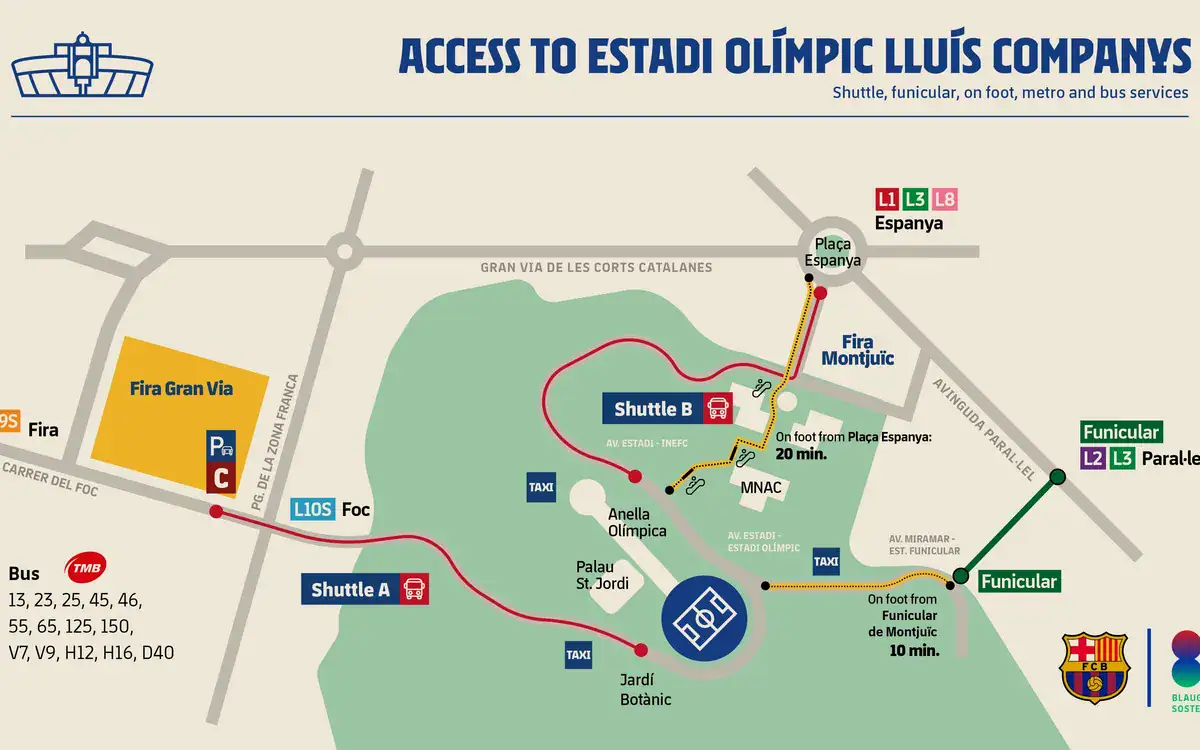
By Metro + shuttle bus (best option on match days)
The closest Metro station to the stadium is Espanya, served by:
- Line 1 (Red)
- Line 3 (Green)
On FC Barcelona match days, free shuttle buses run continuously from Plaça d’Espanya (just outside the metro station) up to the stadium entrance.
- Service starts roughly 2 hours before kickoff and continues after the match ends.
- These buses are divided into convoys of 3 every 4 minutes, which allow them to make a continuous circuit and maximize journeys.
- The buses depart from two separate points to reach the Estadi Lluís Companys; close to Plaça Espanya and on Carrer del Foc.
- Journey time: 15-20 minutes depending on traffic.
By bus
Several TMB city buses serve the Montjuïc area, but they don’t go all the way to the stadium entrance:
- Line 55 (from Paral·lel to Montjuïc). Get off at Estadi Olímpic stop.
- Line 150 (from Plaça d’Espanya to Montjuïc Castle). Stops near the Olympic complex
- Line D20. Stops lower down the hill.
Warning: You may need to walk 10-15 minutes uphill from the bus stop to reach the stadium.
By funicular + walk
You can also reach the stadium by taking the Montjuïc Funicular:
- Board at Paral·lel metro station (L2 or L3).
- Get off at the Montjuïc top station, then walk about 20 minutes through the park to the stadium.
By taxi or ride-sharing
Taxis and apps like Uber, Cabify, and FreeNow can drop you closer to the stadium entrance.
- From city center: 15 minutes
- From Sants Station: 15 minutes
- From the airport: 25-30 minutes
Warning: On match days, access roads may be restricted, and drop-off points can change, so expect to be dropped off a short walk away.
Walking or cycling
Biking is possible, but steep gradients make it more suitable for e-bikes.
From Plaça d’Espanya, it’s a 25-30 minute uphill walk via Avenida de la Reina Maria Cristina.
From Poble Sec or Paral·lel, use the Montjuïc stairs and paths (steep but scenic).
Driving and Parking (not recommended)
Driving is strongly discouraged on match days due to:
- Road closures near the stadium.
- Police controls that limit access to shuttle buses and authorized vehicles only.
- No public parking at the stadium.
How to Buy FC Barcelona tickets (Olympic Stadium)
While Camp Nou undergoes renovation, FC Barcelona home matches are held at the Olympic Stadium in Barcelona. Buying tickets is simple, but demand is often high (especially for top La Liga and Champions League games), so it’s best to plan ahead.
The most convenient and secure way to get your tickets is to buy them online through the official channels.
Step #1: Check the FC Barcelona match schedule
- Look for home fixtures at Olympic Stadium during the current season.
- Dates and times are confirmed only a few days before the match.
- Most games are on weekends, but some may be on Fridays, Mondays, or midweek (for European competitions).
Step #2: Choose your seats
- View the Olympic Stadium Barcelona seating plan and select your preferred zone. You have it below, in the next section.
- Options range from pitchside seats to panoramic views in the upper levels.
- Prices vary based on location and the match category.
Step #3: Confirm and pay
- Fill out your personal and payment information carefully.
- Double-check your email address, as your confirmation and e-tickets will be sent there.
- Tickets are usually issued as mobile passes.
Skip the lines and secure your spot now: book your FC Barcelona tickets at the Olympic Stadium online here.
The purchasing process is very easy, but here’s a complete guide on how to buy FC Barcelona tickets in case you need it.
Learn how to easily access your seats

Navigating the Olympic Stadium in Barcelona is easy once you know how to read your FC Barcelona ticket. The stadium layout is simple and open, but since it was originally built for athletics, there’s a running track between the pitch and the stands, meaning distances and views vary by seating zone.
There are 6 areas of the Estadi Olímpic stadium:
- Tribuna (Tribune)
- Lateral (Longside)
- Corner Nord (North Corner)
- Corner Sud (South Corner)
- Gol Nord (North Goal)
- Gol Sud (South Goal)
Your ticket will include the following details:
Accés (Access gate)
- This is the external gate you’ll use to enter the stadium complex. The gate number appears on a grey panel located right above the gate.
- You can only enter through your designated access gate, so make sure to check the number on your ticket.
- Gates are clearly marked around the venue. The access numbers show up in black on the vertical panels around the entire stadium.
Porta (Turnstile gate)
- Once inside, you’ll need to go through a specific Porta, or turnstile.
- This number is mandatory: you can only enter through the gate assigned on your ticket.
- Present your mobile and scan it at the turnstile for access.
Boca (Entrance tunnel)
- The boca is the tunnel that leads directly to your row.
- The entrance numbers are shown on a horizontal panel, located above each access.
Fila (Row)
- Rows are numbered along the side of the seating areas.
- Numbers increase as you move up from the front row.
Seient (Seat)
- Seats are numbered in order, with even and odd sides of the aisle.
- Once you find your row, your specific seient will be printed on the seat or row markers.
Insider tip: Arrive at least 45 minutes before kickoff to allow time for shuttle transfers, security checks, and finding your seat without stress.
History of Olympic Stadium in Barcelona
The Olympic Stadium in Barcelona, officially known as the Estadi Olímpic Lluís Companys, is one of the city’s most iconic landmarks.
Built in 1927 for the 1929 Barcelona International Exposition, it was originally intended to host the 1936 People’s Olympiad, a working-class alternative to the Berlin Olympics, but that event was cancelled due to the Spanish Civil War (1936-1939).
Olympic transformation (1992)
The stadium sat largely unused for decades until it was completely rebuilt ahead of the 1992 Summer Olympics, where it hosted:
- The Opening and Closing Ceremonies
- Athletics competitions
- Various Olympic cultural events
Its name honors Lluís Companys, the former President of Catalonia who was executed during the Franco regime.
After the Games, the stadium became a multi-use venue and briefly served as the home of RCD Espanyol before they moved to their own ground in 2009.
FC Barcelona’s temporary home
From 2023 to 2025, the Olympic Stadium was the temporary home of FC Barcelona, while Camp Nou underwent a major redevelopment.
- It seats around 55,000 fans during Barça matches.
- Special transport and stadium upgrades were implemented to accommodate the club’s needs.
A living part of Montjuïc
Nestled within the Montjuïc Olympic Park, the stadium is part of a larger complex that includes:
- Palau Sant Jordi (indoor arena)
- Montjuïc Communications Tower
- Olympic Museum and Sports Hall of Fame
Even outside match days, the Barcelona Olympic Stadium remains a symbol of international sport, architectural rebirth, and Catalan history.
Do you need more information on Barcelona?
This article is part of a complete guide about Barcelona where you can read all the information you need to plan your trip to this popular destination in Spain.
Here is a complete summary of all the guide:
1. When to visit Barcelona
2. How many days in Barcelona do you need?
3. How to get to Barcelona
4. How to move around Barcelona
5. Ultimate guide to Barcelona hotels: my top picks
6. What to eat in Barcelona
7. What to do in Barcelona
8. First timer’s guide to the Sagrada Familia Church
9. How to buy your tickets to Sagrada Familia
10. 6 tips for visiting the Sagrada Familia
11. My top 3 Sagrada Familia tours
12. How to buy your Park Güell tickets
13. How to buy your FC Barcelona tickets the easy way
14. How to get to Camp Nou
15. Best day trips from Barcelona
Find out more with ‘Barcelona In 15 Walks’

‘Barcelona In 15 Walks’ is a complete 160+ pages guide featuring exclusive content, relevant websites, rich designed maps and dozens of photos, allowing you to explore Barcelona before you set a foot in Spain.
It contains a detailed step-by-step walkthrough of 15 self-guided walks (and a bonus one!) with all the directions and practical information necessary to go from one highlight to the next.
All the content included in the travel guide is based on practical and organized Barcelona information. Every single self-guided walks has been personally tested to make sure that you can do it on your own. And the best part is that you can download it, and start reading immediately with one click.
